Prayer Unit
Goals:
1. Understand and take ownership in my Christian faith.
2. To live faith as a child and servant of God.
3. Grow in the life and mission of the church.
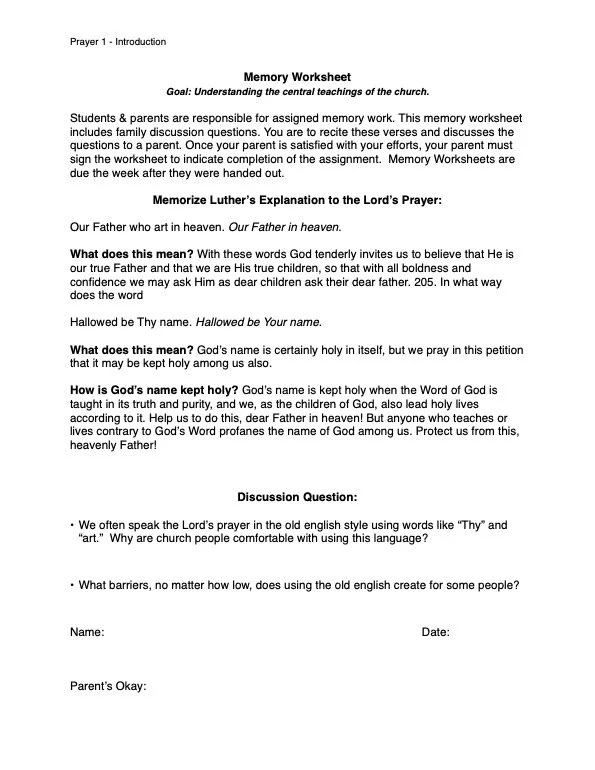 This week we turn our attention to the Lord’s Prayer and God’s desire for heart felt communication from us in our ongoing relationship with Him.
Unit Prayer (Introduction) "Our Father who is in heaven" Given Scripture references The Lutheran Study Bible, Small Catechism, and class discussion, students will know that prayer is talking to God in an ongoing relationship, recall the three reasons we pray, contrast our understanding of prayer to worldly false teachings by identifying the four disclosures of "Our Father in heaven" that enforces our position.
Lesson Notes Prayer 1
Terms
• Advent - Coming. The season prior to Christmas; anticipating the coming of Christ.
• Agnus Dei- “Lamb of God”; a liturgical chant usually sung before Communion.
• Amen - Hebrew word meaning “so be it” or “truly”.
• Art in - Archaic phrasing from the Lord’s Prayer: “who is in heaven”
• Benediction - Blessing pronounced at the end of the worship service.
• Chancel - The area where the altar is located.
• Confession & Absolution - The corporate acknowledgment of sin and declaration of God’s forgiveness.
• Doxology - A hymn of praise to triune God (“Praise God from whom all blessings flow”).
• Easter - The resurrection of Christ from the dead.
• Epistle - A letter from the New Testament
• Eucharist - Holy Communion
• Evil - That which is opposed to God’s will
• Gloria in Excelsis - “Glory to God in the highest” – a hymn of praise to God
• Hallowed - Archaic phrasing from the Lord’s Prayer: “Holy be Thy name”
• Introit - An entrance chant, psalm, or hymn
• Kyrie - “Lord, have mercy”
• Law and Gospel - A key Lutheran theological distinction
• Lectionary - A schedule or table of readings for each Sunday
• Lent - A 40-day season before Easter focusing on repentance, rebirth and renewal.
• Narthex - Gathering at the entrance to the church.
• Nave - Where the congregation sits.
• Pericope - A section (portion) of Scripture.
• Prayer - Communication with God; No relationship can survive without heart felt communication
• Sacristy - The room where the pastor and elders robe up. We call it the brides room.
• Sacristy (Working) - The room where Communion is prepared by the Altar Guild
• Sermon - The spoken Christ center message in the worship service
• Sin - A transgression against God’s will, in thought, word, and deed
• Temptation - The enticement to sin (of which God does not do) or test of faithfulness (of which God can do) (“lead us not into temptation”).
• Thy - Archaic phrasing from the Lord’s Prayer: “Your will be done”
• Trespass - An old term for sin or wrongdoing.
Reason we pray
• Need (We have a need to communicate with God)
• Commandment (God told us to do it)
• Promise (God promises to hear our prayers)
| Aspect | Vain Babbling (Matthew 6:7) | True Prayer |
|---|---|---|
| Heart/Mind | Mechanical, empty, without faith or understanding | Sincere, from the heart, in faith |
| Attitude | Thinks many words or repetition compels God | Trusts God's promise to hear for Christ's sake in faith |
| Purpose | Trying to manipulate or impress (God or others) | Talking with God in faith |
| Examples | Prayers done without faith | Prayers done in faith |
2nd Commandment
You shall not misuse the name of the Lord your God.
What does this mean?
We should fear, love, and trust in God so that we do not curse, swear, use satanic arts, lie, or deceive by His name, but
call upon it in every trouble, pray, praise, and give thanks.
Lesson Notes Prayer 1 Part Two
Prayer is the faithful conversation of God's children with their heavenly Father, offered in Jesus' name, empowered by the Holy Spirit, trusting God's promises and seeking His gracious will.
Prayer is done in faith. Faith in Christ. We should do it regularly and often.
God always answers prayer.
• Yes, Wait, No. (Green Light, Yellow Light, Red Light)
• Never a maybe answer because His is never uncertain or undecided.
1st Commandment
You shall have no other gods.
What does this mean?
We should fear, love, and trust in God above all things.
Prayer with others
- We do not participate in interfaith prayer because God has revealed Himself only in the Triune God through Jesus Christ, and prayer directed apart from Christ is not directed to the true God.
- We are cautious about public prayer with Christians of differing confessions because public prayer communicates a shared confession of faith. We do not want to suggest a unity in teaching that does not exist.
Disclosers that Our Father in Heaven Reveals:
• God loves us and wants us to pray (Personal not impersonal) Q205
• We are children of God (Informal, not formal) Q206
• God has the power to grant requests (Near not distant) Q207
• Heirs not slaves/servants/hirelings
Unit Prayer (1st Petition): "Holy be Your Name" God desires from us heart felt communication. Given Scripture references, The Lutheran Study Bible, Small Catechism, and class discussion, students will explain what we are asking from a Holy God that His name be kept holy and create a list how we keep God's name holy.
Lesson Notes Prayer 1 Part Two
Prayer is the faithful conversation of God's children with their heavenly Father, offered in Jesus' name, empowered by the Holy Spirit, trusting God's promises and seeking His gracious will.
Prayer is done in faith. Faith in Christ. We should do it regularly and often.
God always answers prayer.
• Yes, Wait, No. (Green Light, Yellow Light, Red Light)
• Never a maybe answer because His is never uncertain or undecided.
1st Commandment
You shall have no other gods.
What does this mean?
We should fear, love, and trust in God above all things.
Prayer with others
- We do not participate in interfaith prayer because God has revealed Himself only in the Triune God through Jesus Christ, and prayer directed apart from Christ is not directed to the true God.
- We are cautious about public prayer with Christians of differing confessions because public prayer communicates a shared confession of faith. We do not want to suggest a unity in teaching that does not exist.
Disclosers that Our Father in Heaven Reveals:
• God loves us and wants us to pray (Personal not impersonal) Q205
• We are children of God (Informal, not formal) Q206
• God has the power to grant requests (Near not distant) Q207
• Heirs not slaves/servants/hirelings
 Unit Prayer (2nd & 3rd Petitions) "Your kingdom come. Your will be done on earth as in heaven" With the help of the Holy Spirit, students can come to understand the desire of God for heart felt communication through prayer. Given Scripture references The Lutheran Study Bible, Small Catechism, and class discussion, students will, through the 2nd Petition, identify the 3 kingdoms of God and explain what we are asking through this petition, "Your Kingdom Come". Through the 3rd Petition, students will name the four parts to the Good and Gracious will of God and identify the differences between the Scriptural definition of the Will of God to descriptions used in our culture.
Lesson Notes Prayer Three
Your Kingdom Come
What does this mean? The kingdom of God certainly comes by itself without our prayer, put we pray in this petition that it may come to us also.
How does God’s kingdom come? God’s kingdom comes when our heavenly Father gives us His Holy spirit, so that by His grace we believe His holy Word and lead godly lives here in time and their in eternity.
Kingdom of God
• Kingdom of Power (All of creation)
• Kingdom of Grace (the church on earth)
• Kingdom of Glory (heaven)
God’s Kingdom come to us in two ways;
• It is here now, in time, through the Word and faith (Grace)
• It comes through the final revelation in eternity (Glory)
Your will be done on earth as in heaven
What does this mean? The good and gracious will of God is done even without our prayer, but we pray in this petition that it may be done among us also.
How is God’s will done? God’s will is done when He breaks and hinders every evil plan and purpose of the devil, the world, and our sinful nature, which do not want us to hallow God’s name or let His kingdom come; and when He strengthens and keeps us firm in His Word and faith until we die. This is His good and gracious will.
Q215 The Good and Gracious Will of God
• His Name be kept Holy among us
• That His Word is taught correctly
• that sinners be brought to faith
• That we lead godly lives
Your Will Be Done
• God desires all to be saved
• Faith in Jesus = life
• The devil, the world, and our sinful natures have their own ideas of what is “good”
• Bad idea to add to God’s commandments
• Consequences
 Unit Prayer (4th & 5th Petitions) "Give us this day our daily bread. Forgive us our sins as we forgive those who sin against us." With the help of the Holy Spirit, students can come to understand the desire of God for heart felt communication through prayer. Given Scripture references The Lutheran Study Bible, Small Catechism, and class discussion, students will, identify the reasons why we ask God for our daily bread; Define the meaning of "daily bread" in both the narrow and broad sense; Explain why we pray "daily" and "this day" in this petition; justify why we are saved by Grace alone through Faith alone when we ask for forgiveness as we forgive others; Explain the Lutheran understanding of effects from original sin.
Lesson Notes Prayer Four
Give us our Daily Bread
What does this mean? God certainly gives daily bread to everyone without our prayers, even to all evil people, but we pray in this petition that God would lead us to realize this and to receive our daily bread with thanksgiving.
What is meant by daily bread? Daily bread includes everything that has to do with the support and needs of the body, such as food, drink, clothing, shoes, house, home, land, animals, money, goods, a devout husband or wife, devout children, devout workers, devout and faithful rulers, good government, good weather, peace, health, self-control, good reputation, good friends, faithful neighbors, and the like.
Stewardship Issues
• Trust; Who am I trusting? God or is it my stuff?
• Listen; Who am I listening to God? The World? Myself?
• Understand; Do I understand where this all comes from in the first place?
Q219 Reasons why we pray for daily Bread
• (Understand) Realize life depends on God
• (Listen) To receive blessings with Thanksgiving
• (Trust) Have us look to God for all
Daily bread in the narrow and broad sense:
• Narrow sense - Only food and drink
• Broad sense - Food, clothing, home, work, good government, health, and reputation
Benevolence:
• Q221 Help provide for those unable to work (1Timothy 5:8)
• Unwilling to work do not eat (2Thessalonians 3:10-12)
Forgive us our trespasses as we forgive those who trespass against us.
What does this mean? We pray in this petition that our Father in heaven would not look at our sins, or deny our prayer because of them. We are neither worthy of the things for which we pray, nor have we deserved them, but we ask that He would give them all to us by grace, for we daily sin much and surely deserve nothing but punishment. So we too will sincerely forgive and gladly do good to those who sin against us.
Not a qui pro quo
• Faith alone, Grace alone, Christ alone
• God has forgiven us, we willingly forgive others.
• Q227 We sin every day and deserve nothing put punishment
• Look to Christ
• We live in a state of Grace
Q227 Forgiving others reminds us that God forgive us
• We remember the promise of our forgiveness
• Our lives are full of examples of our need for forgiveness
Q226 We are to do good to those who sin against us.