Sacrament Unit
Goals:
1. Understand and take ownership in my Christian faith.
2. To live faith as a child and servant of God.
3. Grow in the life and mission of the church.
 Unit Sacraments (Baptism) Baptism is one of the means through which the Holy Spirit works to connect us with the work of Christ. With the help of the Holy Spirit, students will come to appreciate the benefits, the mystery, and the Lutheran understanding of the sacraments. Given Scripture references The Lutheran Study Bible, Small Catechism, and class discussion, students will identify the visible element of Baptism; explain the meaning of "one baptism for the remission of sins.”; come to view baptism as part of the Gospel; and define the biblical definition of Baptism.
Lesson Notes: Sacrament Baptism
Requirements for a Sacrament
1. Instituted by God
2. Visible Element (Water, Bread & Wine)
3. God's Word (God is doing the work)
4. For the forgiveness of sins
Q241
Law / Gospel differences
Law - No forgiveness (a work)
Gospel - Forgiveness (a gift)
Grace - Unmerited favor
God's
Redemption
At
Christ's
Expense
Work
• God is does the work
• Faith of the pastor does not matter (God's Work)
• Normally called ministers baptize out of good order in the church.
Hope in Christ
• There is more to it than a place in heaven, an escape from life.
• The Hope we have in Christ is to be Special, Loved, Wanted, Included, Valued, Disciplined, Noticed.
• The Hope we have in Christ is to have a life not defined by the world.
• The Hope we have in Christ is the way out of despair. It is the Hope to a start over. It is to live.
| Paraphrasing
on what Baptism/baptized means in the passage. The study notes may prove helpful |
||||
|---|---|---|---|---|
| Scripture | Study Notes | Key Class 1 | Key Class 2 | Key Class 3 |
| Mark 1:4 And so John came, baptizing in the desert region and preaching a baptism of repentance for the forgiveness of sins. | Acceptance into the community of God’s chosen people; removes the guilt of sin | Call to live out faith | Removes guilt | Living faith |
| Luke 20:4 John’s baptism — was it from heaven, or from men?” | They admit to rejecting the divine origin of John’s message. In this rejection, they proved more hard-hearted than the common people. | From Heaven | From Heaven | From God |
| Romans 6:4 We were therefore buried with him through baptism into death in order that, just as Christ was raised from the dead through the glory of the Father, we too may live a new life. | We are united to Christ’s death and burial so that we will be united to His resurrection and life. by the glory of the Father. God’s power was gloriously revealed in the resurrection. walk in newness of life | Connects use to Christ | United [in Christ] | New Life |
| Colossians 2:12 having been buried with him in baptism and raised with him through your faith in the power of God, who raised him from the dead. | Baptism puts to death the sinful nature and resurrects us in faith to a new life in Christ. | New Life | Salvation | Connects me to Jesus |
| Peter 3:21 and this water symbolizes baptism that now saves you also — not the removal of dirt from the body but the pledge of a good conscience toward God. It saves you by the resurrection of Jesus Christ, | We are forgiven and holy because of Christ. That forgiveness is applied to us in Baptism. | Power... Makes you holy | New Heart | Saves me |
| Matthew 3:6 Confessing their sins, they were baptized by him in the Jordan River. | Those who were baptized and confessed their sins could be certain of the forgiveness of sins | Produces fruit | Gives asolution | Makes us holy |
| 1Corinthians 10:2 They were all baptized into Moses in the cloud and in the sea. | A metaphor for the Israelites who passed through the waters of the Red Sea and emerged a new people, saved from slavery. | A new people | Adopted into the Family | Become God’s children |
| Mark 16:16 Whoever believes and is baptized will be saved, but whoever does not believe will be condemned. | God’s grace is offered through Baptism. Baptism is not a work that we offer to God. | Faith | Produces Faith | Faith |
| Galatians 3:27 for all of you who were baptized into Christ have clothed yourselves with Christ. | God incorporates believers into union with Christ. His righteousness becomes theirs. | United in Christ | Makes us hiers | Makes me Holy |
Class Definitions
2007 Connects us to Christ, Saves us, A living Faith, Forgiveness, makes us a child of God.
2020 Baptism is call to a living faith that is from God for a new life connected to Jesus who saves me through the forgiveness of sin. By faith I am a child of God Who makes me holy.
2021 God removes my guilt of sin through absolution, providing the saving faith that makes me holy through the holiness of Jesus Christ. For Christ’s sake, I now belong to Him and am a member of God’s family.
2022 Baptism is God’s call to live in the faith that comes from heaven, uniting us in Jesus Christ for our salvation. Through Baptism, God gives the power to save us from sin, grants forgiveness through faith, joins us to His family, and makes us heirs of His kingdom.
2023 Baptism is God’s call to a living faith and a new life united to Jesus Christ, who saves me through the forgiveness of sins. By faith, I am a child of God, and He makes me holy.
2025 In Baptism, God gives a living faith from heaven, uniting us in Christ and granting new life and a new heart. Through faith, He makes us holy, creates us as a new people, and unites us into God’s family.
2026 Baptism is God’s work by which He forgives sins, delivers us from sin, joins us to Christ’s death and resurrection, creates and strengthens faith, clothes us in Christ’s righteousness, makes us holy, and gives salvation.
Unit Sacraments (Baptism 2) Baptism is a work of God for the forgiveness of sins. With the help of the Holy Spirit, students will come to appreciate the benefits, the mystery, and the Lutheran understanding of the sacraments. Given Scripture references The Lutheran Study Bible, Small Catechism, and class discussion, students will know the reasons for baptizing babies; justify the position that Baptism is a work performed by God not by man; provide scriptural evidence to questions regarding Baptism; and conclude that salvation is by faith alone through grace alone.
Lesson Notes: Baptism Follow Through
Only Unbelief Condemns (Mark 16:16, Luke 23:30-43)
The Word Baptize
• Immersing in water
• Washing with water
• Rinsing with water
Q239
Terms
Old Adam - Our corrupt human nature
New Adam - New life in Christ Jesus
Q255
Benefits of Baptism
• Provides faith (a means through which the Holy Spirit works)
• Inclusion into the family of God
• Forgiveness of sins, rescue from sin, death and the devil ∴ Salvation
• Anointed for mission
Q248, Q253, Q254
Infant Baptism
1. All nations (Acts 2:38-39)
2. Invitation (Luke 18:15-17)
3. Sinners (Original Sin)
4. Faith (Work of the Holy Spirit)
Q244, Q246
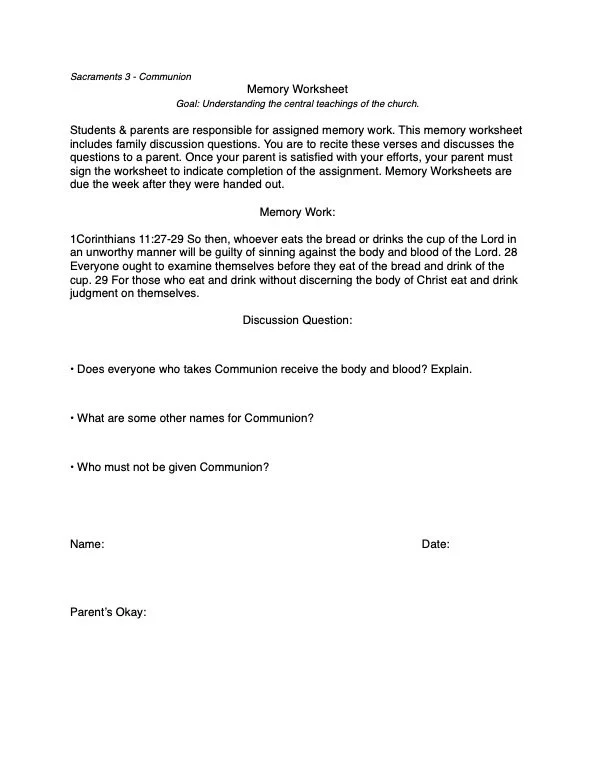 Unit Sacraments (Communion) On the night he was betrayed, Jesus established the Lord's Supper – a means of Grace through the Holy Spirit works. With the help of the Holy Spirit, students will come to appreciate the benefits, the mystery, and the Lutheran understanding of the sacraments. Given Scripture references The Lutheran Study Bible, Small Catechism, and class discussion, students will explain the local practice for receiving the sacrament; Identify the benefits of Holy Communion; know the significance of the two dimensions of Communion; Compare and contrast our understanding of Holy Communion with other Christian groups.
Lesson Notes: Communion
Terms
Material Principle - Center of theology
Formal Principle - Source of religious truth
Sacrament - Mystery; Mystery of God
Eucharist - Thanksgiving
Closed Communion - Open to those with the same confession of faith
Open Communion - Open to everyone
Passover
• Communion is linked to the Passover found Exodus
• Jesus was celebrating the Passover Meal with His disciples when He instituted the "Lord's Supper"
- The Four Cups of Passover
• 1st I will free you
• 2nd I will deliver you
• 3rd I will redeem you (when communion is established)
• 4th will take you to be my people
Names for Communion
• Holy Communion
• The Lord's table
• The Lord's Supper
• Eucharist
• Sacrament of the Altar
Divergent Views
• Symbolicism - Understood as only a word picture.
• Transubstantiation - Bread and Wine are changed into the actual body and blood of Christ.
• Consubstantiation - The substance of Christ's body and blood combines with the substances of bread and wine to form a third substance for the Sacrament
• Receptionism - The notion that Christ’s body and blood are only present when received by the celebrant who believes it to be present.
• Sacramental Union - The real presence of the body and blood of Christ is united with bread and wine. Sometimes described as being; in, under, and above the elements without changing them. His real presence is in the Sacrament regardless of what the celebrants think or believe.
Distribution
• Common Cup
• Individual Cups
• Intinction - the practice of receiving Communion by dipping the host into the wine before consuming it.
Greetings
• Bread
•Take, eat; this is the true body of our Lord and Savior Jesus Christ, given into death for your sins.
•The true body of Christ, given for you.
• Wine
•Take, drink; this is the true blood of our Lord and Savior Jesus Christ, shed for the forgiveness of your sins.
•The true blood of Christ, shed for you.
• Dismissal
•The body and blood of our Lord Jesus Christ strengthen and preserve you in body and soul to life everlasting. Depart in peace.
Lesson Notes: Communion Session 2
Desirable Prerequisites
• (1Corinthians 11:24) Implies for those who receive the sacrament a knowledge of the event of Calvary and faith that what happened there was for them. !
• (1Corinthians 10:16). Implies the recognition that the Savior is present in the sacrament and that he gives his body and blood to the believer for the forgiveness of sins.
• (1Corinthians 11:26) Implies knowledge of the Lord's promise of his return and faith to trust his promises.
• (Matthew 26:28) Implies a recognition and acceptance of God's grace.
• (1Corinthians 10:17) Implies that the communicant acknowledges Christ as Lord and fellow believers as brethren in this one Lord.
Public Confession
• Communion is a public confession of Christ and the unity of His Gospel (1Corinthians 10:17).
• Excludes members from other churches in other denominations (Altar Fellowship)
• Easter and Christmas Eve has the largest visitor attendance
• Many of these visitors have no ongoing relationship with the congregation
• The lack of a relationship impedes our ability to show reverence to God’s will where it concerns who we will admit
Reasons to withhold
• Faithlessness
• The unrepentant
• Of a different faith
• Those unable to examine themselves
Q299, Q305
Confessional Highlights
• Communion is not to be forced upon us as it was under the papacy (SC 340.21, LC 452.51)
• Communion should not be bound to special times (LC 452.47)
• No distinctions can be made between clergy and laity (Apology 237.9)
• Adoration of the sacrament elements is rejected (Epitome 486.40; SD 591.126)
• Words of institution are never omitted (SD 584.79)
Frequency (Two faithful Lutheran Perspectives)
- Both sides affirm:
• Real Presence “in, with, and under” bread and wine
• Communion is God’s gift to us, not our work for God
• Need for teaching and pastoral care
• Strengthens faith and provides assurance of forgiveness regularly
• Must be received in repentant faith
• We must avoid neglecting of the Sacrament
• Closed Communion (Public Confession)
- Every Sunday
• Communion is not an optional add-on
• Worship feels incomplete without the Lord’s Supper
• Historic practice; less frequent was a late development
- Every Sunday Risks
• Repeated practice shapes expectations more than words alone
• Risks making the Sacrament routine or ordinary; the gift becomes an expectation
• Subtly turns Gospel into Law (guilt for missing, measure of faithfulness)
• Shifts the focus away from what Christ has done to the Means of Grace itself
• Imparting of unintentional lesson that faith in Christ plus Communion saves; Me and Christ working together for my salvation
• May make worship feel “incomplete” without Communion
• Increases pressure on closed communion and pastoral care
• People who desire weekly reception should not have to “shop” services or feel restricted.
- Biweekly
• True worship does not require Communion every service (The Word is sufficient)
• Frequency is a matter of Christian freedom (adiaphora)
• Historic practice of by-weekly was not seen as neglect.
- Biweekly Risks
• Can treat the Sacrament as rare/special in a way that makes it feel like a reward for the especially pious rather than comfort for all sinners.
| Aspect | Biweekly Position | Weekly Position |
|---|---|---|
| View of Worship | The Word is sufficient | Word + Sacrament |
| Frequency | Historic norm for biweekly | Historic norm for weekly |
| Primary Concern | Refelect Gospel character, avoids Law formation | Avoids neglect |
| Risk Highlighted | Weekly becomes routine, ordinary; expectation | Biweekly becomes too rare; special |
| Public Confession | More sustainable |